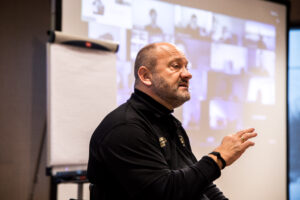

What do you think about monitoring in the workplace? Do you say, "Great, monitor me! Then I can achieve my goals"? Or do you view the word with suspicion, and does monitoring mean nothing more to you than a lack of trust?
Control in the workplace and beyond is an interesting area of tension. It can be worthwhile to explore this topic: What does control have to do with self-confidence? Is there a connection to our fear of failure? What does control trigger in our minds? And how does control affect us in the workplace?
Between appreciation and self-esteem
Control – a strange word, a strange value, and a narrow concept. But in order to understand the term as such, we need to put our mental attitude the test – and with it our view of trust, mistrust, and control.
Only those who do not trust control.
We quickly deduce a lack of appreciation and reduced self-esteem from this frequent association. But let's understand control in the workplace and beyond as a tool that helps us achieve our goals. Take Formula 1, for example: no racing driver would interpret being shown the lap times for his cornering as a lack of trust. The control helps him drive more efficiently and win.
Nevertheless, we quickly feel attacked when we receive feedback. We feel thrown back on ourselves. We constantly seek validation and have little interest in feedback from life. In short, we have a self-esteem problem. Feedback means "praise me!" Have you ever heard anyone ask for feedback and want to be criticized?
Too much mistrust and lack of control during the crisis
If we are honest, we control everything from morning to night—even far away from the control of our workplace, we are real control freaks! Even our toothbrush tells us when we are done. But right now, in this crisis, we have no control, and that makes us feel insecure.
How exciting is that?
Now the big question is: Are we able to balance mistrust and control and consciously recognize the help that control can bring us? mental attitude a choice we make for ourselves. And this personal growth only works through systematic feedback.
Put your mindset to the test: Consider whether you can actively change your mindset and recognize that control
- has nothing to do with your self-worth,
- does not want to question,
- and do not want to damage your reputation.
Control is not a toggle switch mechanism
Let us now turn to the two concepts in this tension: trust and mistrust.
If mistrust and control essentially mean the same thing, and trust is equated with the absence of control, then the ability to differentiate between trust and mistrust is equivalent to one and zero—on and off. But that is too simplistic a view.
In the toggle switch mechanism, there is no area between on and off. However, between too much and too little trust, there is a corridor that we call "Smart Trust." Here, trust and mistrust are equally balanced. From this corridor, the path to blind trust is still a long way off—but so is the path to complete distrust. The corridor of smart trust increases our ability to differentiate.
For example, we repeatedly encounter people in whom we have enormous professional confidence. However, we distrust the way some of them assert their own interests. Depending on the context, we can therefore assign and apply trust and distrust differently.
Understanding workplace monitoring for what it is
People who have been wrapped in cotton wool their whole lives see control in the workplace and beyond as criticism. This is a self-esteem issue that we have in the world. These people cannot bear all the negativity, darkness, and pain, but when we introduce controls, it is to get closer to our goals. So let go of the mindset that equates mistrust with control. Ultimately, it only shows that your self-esteem cannot handle criticism.
Our task for you:
Take a look in the metaphorical mirror: What effect does control in the workplace have on you? Make it visible and consider: Can you perceive control positively? Find your corridor of wise trust. Look for what lies between trust and mistrust. Observe how new things move in this corridor from mistrust to trust. As soon as we fail, they may slip back a little. Smart Trust trusting to a high degree while remaining vigilant. Find the golden mean. For personal support in dealing with this topic, contact the Grundl Leadership Institute.
That's why you're not really happy.
Why success and fulfillment have nothing to do with each other.