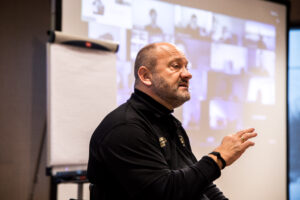

The newsroom is the heart of communication. This is where news is received, passed on, and processed. In addition to the strategy team, media and topic desks, this is where the editor-in-chief sits. He is responsible for managing the communication process. He bears responsibility, provides leadership, and must simultaneously embody trust.
Leading, moderating, managing. The range of tasks performed by an editor-in-chief is vast. In the newsroom, the editor-in-chief acts as the link between the topic desk and the media desk, thus serving as an intermediary between the company and the media. He or she performs the necessary communication work by forwarding work assignments to the topic desks and media desks.
Leading an editorial meeting requires both authority and understanding. It is therefore important to fill the position with an experienced individual. The editor-in-chief must think like a journalist, act decisively, and never lose sight of the big picture. It is a task that requires tact and, at times, decision-making power—often associated with the potential for conflict.
As leader , the editor-in-chief leader responsibility, but must also delegate it. He embodies self-efficacy, but also wants to inspire it in others.
responsibility a concept
Psychology highlights several aspects with regard to the concept responsibility : Attribution plays an important role here, as it refers to the attribution of causes to events and behavior. In short, it asks the specific question: Who has what expectations of the person responsible in their respective role?
The standards according to which we act here always relate to two value systems. The first is society, the external world, in which the issue responsibility is responsibility accepted. The second value system, on the other hand, is the self, the inner workings of the human being, one's own thoughts on responsibility.
In the case of the CvD, the focus is on his own sense of responsibility in order to become more involved as a self-reliant person. However, this high level of responsibility also means a high level of Result Orientation.
The position of editor-in-chief requires a multidimensional view of responsibility
When considering external responsibility, however, it is important to focus attention on employees and their areas of responsibility. It is important responsibility to them about responsibility in equal measure and to encourage them to experience self-efficacy.
A manager who wants to be highly responsible must delegate projects to employees in such a way that the results are satisfactory and effective. This requires the right assessment. Once employees identify with the responsibility assigned to them, the result is increased motivation within the company and better quality of work.
The editor-in-chief is essentially a designer—with a clear understanding of responsibility.
And to live self-efficacy, he must believe in it.
How do we develop such a leader?
"leader leader still hardlyleader in terms of the quality of their responsibilities,"says Boris Grundl. The only differences are in experience and, in some cases, age. This raises the question: Are leader role models, and do they even need to act as such?
It is the task of leader, such as the editor-in-chief, to increase the company's success, responsibility , and set an example through their own approach to the issue. This creates a culture of trust and exchange at all levels. Although the editor-in-chief's range of tasks includes leadership, in this case it is more a matter of guiding and introducing individual tasks. Due to our own self-esteem, it is always more difficult to recognize our own limits than those of other people. Thus, the CvD is a role model in bearing their own responsibility , in doing so, also in experiencing self-efficacy.
Leading, moderating, and managing. Being responsibility your responsibility while recognizing limits and delegating tasks through experiencing self-efficacy. responsibility and letting others take responsibility—that is leadership.
Yours, Christoph Moss
Collaboration: Sophie Moss
Image source: ©Pexels Pixabay