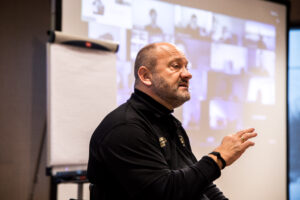

"That doesn't motivate me," says my inside sales representative. She crosses her arms, leans back in her office chair, and pushes her lower lip forward. She looks at me, the marketing and sales director, defiantly. I had just presented a new sales strategy. Twenty-two employees are present. Forty-four eyes look at me with anticipation. They are waiting for my reaction. I can literally hear their thoughts: How will he handle this? Will he lose his composure? They stare at me. Silence. I wait. Then I say calmly, "I don't motivate anyone, I work with motivated people."
"That's mean," some will say."Finally, someone's telling it like it is,"others will say. But what is actually mean? When you redirect the exaggerated expectations of dependent consumers like this sales representative? When you redirect the energy of the attack back to its source, as in judo? And thereby force her to think about herself and her level of personal responsibility? That's not meanness. That's clarity.
There is nothing that hinders your leadership role more than employees who you have to whip into action for every single task. Employees who think that the leader responsible for their motivation, their mood, their happiness. Such emotional leeches remind me of athlete's foot: easy to get, hard to get rid of.
Of course, leadership must inspire motivation. The question is, however, how?
Energetic motivation is a relic of the past. The days when mass motivational speakers filled auditoriums and whipped thousands of people into a frenzy with their "chakka" and "walking on hot coals" are over. What happened on a large scale back then still often happens on a small scale today. The idea that someone else has to motivate me is an admission of failure in terms of my level of personal responsibility.
Motivation through leadership—that is the answer for today. This means that I encourage others to think by asking challenging questions.
- How clear are my goals?
- How important are these goals to me really?
- Will I manage to achieve my goals step by step?
- Are my expertise and experience sufficient to achieve the goals?
Motivation arises when someone wants to show others what they have discovered within themselves. That is why motives change greatly in the course of personal development. While the motive of "wanting to show others" is often at the forefront for someone starting their career, an experienced employee is driven by their contribution to the "big picture." What a difference!
Human development means empowering others to to achieve a higher level of personal responsibility.
Easier said than done. But basically, that's what it's all about: enabling people to take more and more responsibility for themselves. Being responsible means finding answers to the challenges they encounter in their professional lives. Imagine if every employee had a quote from the brilliant Maria Montessori written on their forehead: "Help me to do it myself." Those who follow this sentence do leader right as leader .
That's why you're not really happy.
Why success and fulfillment have nothing to do with each other.
Image source: ©Pixabay – mark-weaver