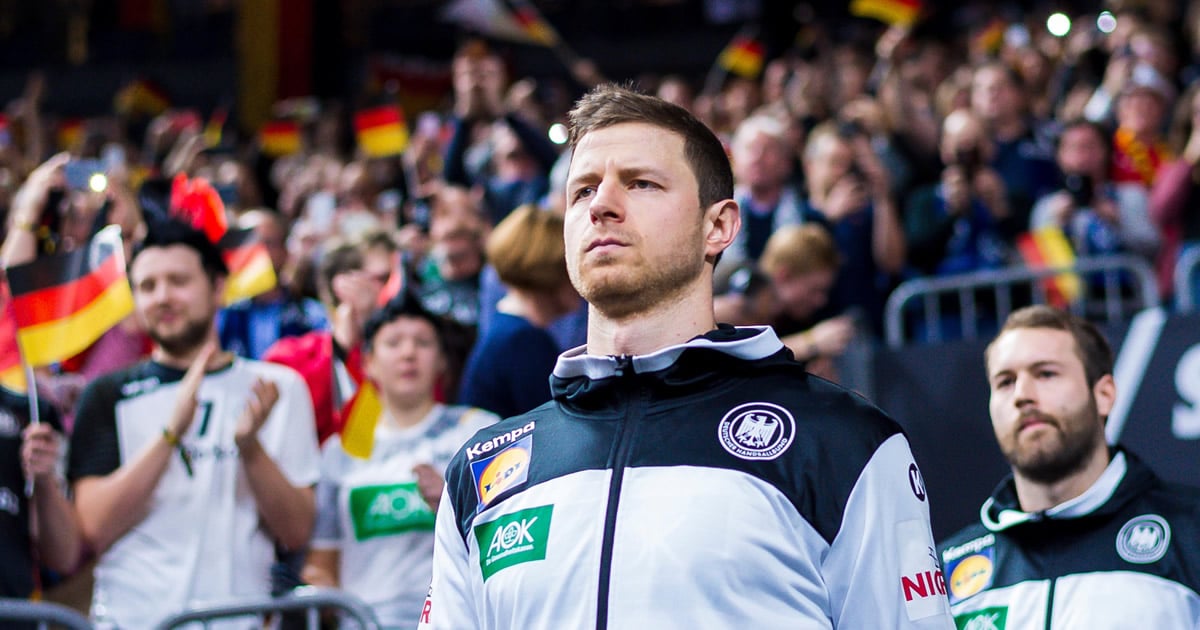
...was probably what many spectators thought when they saw me lying on the floor at Cologne's LANXESS Arena on January 21, 2019. During the match to qualify for the semifinals of the Handball World Championship in Germany, I twisted my knee so badly that quite a lot was damaged—including my dream of reaching the semifinals in my own country and keeping alive the chance of winning a medal with the national team. How can you manage to stay positive in such a situation?
And now? – Always think positively
What lessons can be learned from such an accident? Most people would probably say that there are no positive ones. But I can tell you that I have gained a great deal of positive insights for myself and my ability to motivate others, and I would like to share one of them with you:
Of course, an injury like that causes a lot of pain, and some people might think that in that situation you can't think about anything else—or that you don't think about anything else. In my case, it was different. For a brief moment, I was alone with my thoughts. It was as if everything was happening in slow motion, and I was not really aware of the nearly 20,000 spectators, teammates, and therapists. Many thoughts raced through my mind in a matter of seconds. What fascinated me was that these thoughts could be organized extremely quickly. At least for that fraction of a second, strong, positive thinking arose automatically.
Then the noise returned—as quickly as it had gone—and I heard the therapists and doctors asking me where it hurt and the paramedics carrying me off the field.
Organize thoughts
It was precisely this intuitive classification of my thoughts that helped me greatly to accept my injury—but even more than that, to embrace it and deal with it. In the hours that followed, I thought intensively about myself and my health. Somehow, I had to learn the necessary self-acceptance. Selecting certain thoughts meant that I never sank into self-pity from the outset. It was clear to me: my knee is now damaged. I won't be able to play handball competitively for at least the next six months. In principle, this thought, or rather the realization of such a fact, is a shock for any athlete. In a way, it was for me too. But my focus on the coming hours and days was stronger. Thinking positively and staying positive is extremely important for self-healing, because self-pity would not have been able to answer some of my questions in this regard. I wanted clarity about the course of my treatment. It was very helpful for me that I had already decided during my career which specialist I wanted to see in the event of a knee injury. This enabled me to communicate with my contacts in the association and club in such a targeted manner in the hours that followed that it quickly became clear what needed to be done and how to proceed. I feel that this gave me an incredible amount of confidence to deal with the situation self-assuredly. My motivation was to be ready to play again as soon as possible. Once the diagnosis was confirmed, the suspicion of "total damage" (according to the doctor) was confirmed, and the operation was scheduled for the next day, this confidence grew even stronger—even though the news was getting worse and worse. Deep down, I knew that I had time to take care of my body and my self-healing.
It was only a few days later that I realized I hadn't shed a single tear in the first few days after the accident. Even though at that moment it was about losing the game, participating in the World Cup, the season, and of course my career. However, I was so focused on the immediate healing process that these thoughts only came to me days later at night in the hospital, when I was truly alone. In those moments, the turmoil of the past days and weeks really subsided and the emotions could—and, in my opinion, should—come out.
Insight: Attitude & Perspective
Accepting a certain situation or personal fate can be difficult to varying degrees. In my case, I did so successfully and realized once again how well you can deal with such a situation with the right mindset. The key is to learn self-acceptance in order to overcome self-pity. Injuries can happen in my profession—I expose myself to this risk every day. I was mentally prepared for this one case and had planned ahead in recent years, probably partly subconsciously. That's why I knew exactly which doctor I wanted to be treated by. To this end, my thoughts drew on my own experiences, but also on the results of other athletes. This gave me the confidence described above to not wallow in self-pity, but to cope with the situation and promote self-healing.
From this, I conclude today that it made perfect sense to think about certain topics and situations in advance so that I could react as quickly and intuitively as possible in an emergency.
Everyone has issues in their personal or professional life that can throw them off track. Focusing on your inner plan in these situations can help you make the best of them.
However, that is entirely up to you.
Yours, Martin Strobel
[mks_col]
[mks_one_half] [/mks_one_half]
[mks_one_half]Martin Strobel is a German handball player (HBW Balingen-Weilstetten) who was forced to withdraw from the 2019 World Championship after suffering a serious knee injury in the main round.[/mks_one_half]
[/mks_col]
Images: © Marco Wolf