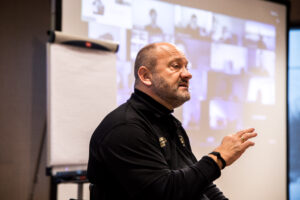

"Who among you is self-employed?" Four hundred pairs of eyes look at me. Only a few hands go up, those of entrepreneurs, owners, and perhaps managing directors with a stake in the company. The employed listeners look uncertain. I repeat my question a little louder. "What does he want from us?" is written on their faces. I ask even more intensely: "Who among you is self-employed?" Now, slowly but surely, all hands go up. For most people , being self-employed seems to describe an employment relationship. But in the dictionary, self-employed is described as independent, not controlled by external forces, and free in one's actions.
Culture of dominance and obsession with control
Being self-employed is more of a mental ability to live a life of personal responsibility than a technical term in labor law. And many companies demand employees who think for themselves and work independently. At symposiums, the entrepreneur within the company is celebrated as the ideal. But what is the reality in companies? Thick HR concepts and colorful CI brochures preach independence, but a culture of dominance and control freakery produces serfs. The entrepreneur within the company degenerates into a mirage that costs vast sums of money year after year because valuable potential remains untapped.
Two poles stand opposite each other: the culture that encourages personal responsibility and consistently demands its implementation, and the opposite pole, where independence is talked about but a culture of guilt prevails. The latter produces slaves and followers through manipulation. By instilling guilt, people are oppressed and made dependent. This is a method born of mistrust. Companies and leader off the exploitation of dependents. In doing so, they overlook the fact that their manipulation castrates employees and diminishes them.
zest for responsibility
But they do exist: companies that consistently focus on human development! They attract enterprising, like-minded people whoresponsibility zest for responsibility . Here, the focus is not on guilt, but on responsibility even in the choice of words. Transparency, clarity, and a systematic approach are used to mutually encourage and challenge each other. A climate of intellectual growth leads to material growth. Employees are positively influenced, not manipulated.
Manipulation is the tool of galley drummers who pretend to offer freedom but rely on exploitation. The method: demanding high results but denying the necessary decision-making power. Like a harem guard who is supposed to father children. Manipulation is obscuring. Smoke bombs instead of clarity. It causes employees to unconsciously surrender their freedom. These are the burnout victims of tomorrow. Because burnout always involves both personal and external factors: stress and external control from outside, restlessness and joylessness from within.
Trust is the fertile ground
In progressive companies, influence bears rich fruit. It is open, transparent, convincing, and meaningful. It encourages people to open up. Trust is the foundation of this culture. Practicing trust requires inner strength and the willingness to endure hurt. It is this transparency and honesty that lead to self-control and independence. When you influence people transparently, you unlock their potential because you have a motivating and inspiring effect. In this way, you turn followers into co-thinkers and the oppressed into entrepreneurs who shape rather than manage. This makes responsibility ! So make a decision and stand by it: Manipulation? No! Influence? Yes!
That's why you're not really happy.
Why success and fulfillment have nothing to do with each other.
Image source: Анастасия Гепп on Pixabay