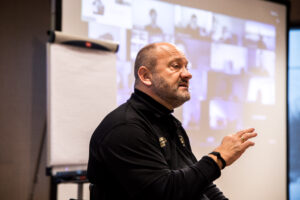

Anyone who has ever seen Boris Grundl live, at an impulse event or management training course, will remember the following story: He is at the airport checking the current flight connections. Suddenly, someone pushes him aside with his wheelchair because they think they need to help the poor, helpless man. Is that appropriate? Hardly. But why does it happen? Clearly, because we project our view of things, our thinking, our worldview onto the current situation.
To illustrate this psychological filter and its various effects, here is another example. Twelve years ago, when I was visiting a friend, the following happened:
At that time, I was running a successful business, which then went into a tailspin due to what I thought at the time were exclusively external factors. Arson completely destroyed the infrastructure: the building, the instruments... After I had to finance the new building with my own money, various customers stopped paying for some of the subsequent orders. It was exasperating.
At the time, my acquaintance lived in a house with surrounding land. He owned several cats. One of them was literally "run over" in a traffic accident. Every bone in its body was broken, but it healed again later. The tail, which at the time of the accident resembled an accordion, could not be saved and had to be amputated. Traumatized by this accident, it took the cat a long time to start approaching strangers again. But this animal noticed me, came up to me after a few seconds, and threw itself down in front of me with the typical cat invitation:"Pet me."
snow from the day before yesterday
And now here's the thing: for weeks after the operation, the cat ran around in circles. Why? Right, she was looking for her tail. But on the day of my visit, the animal stood in the room as if electrified, peered through the glass pane, and spotted a mouse. Finally, it raced through the cat flap like a bolt of lightning. What had it completely forgotten at that moment? That's right: its missing tail. Its natural instinct was stronger than the search for the irretrievable.
This situation mirrored my own predicament. Suddenly, I realized that I had been complaining. In the past, before my company went into a tailspin, X and Y had been much better... But then life did to me exactly what it had done to the cat—it wounded me deeply. So I blamed my circumstances for my misery—and thus gave them power over me. I felt incomplete, exposed, almost powerless. That was my attitude at the time. The only thing I had left—and the most important thing—was my unbridled will to never give up. Thanks to the cat's behavior, I realized: it was ancient history. I no longer needed the missing piece, nor did I need regret...
When Thomas Alva Edison's laboratory burned down completely in December 1914, he is said to have said something like this to his son and wife:
"Such misfortune is actually a wonderful thing! All our mistakes and errors go up in flames, and we are in the fortunate position of being able to start all over again from scratch."
This also shows that the psychological filter has various effects.
In the form described above, it meant to me: I am holding on to something. I regret that I no longer have the status quo of the past. In addition, I want others to feel sorry for me, for how badly I have fared. How bad the world and people are, who have obviously all conspired against me. At the time, the filter prevented me from realizing that it was precisely this regret that was taking away my freedom (and responsibility!). It prevented me from having an unbiased attitude toward the "lost cat's tail." At that point, I was no longer able to control my thoughts freely and interpret events in a way that would have allowed me to realign myself.
Look ahead
I therefore invite you to reflect on your life. Where are you clinging to things that you no longer need, that may even hinder you today or tomorrow on your path of further development? Similar to the caterpillar before its metamorphosis into a butterfly: if the caterpillar did not pupate, did not transform its physical body, it could never become a beautiful butterfly. It must shed its old body. Everything is good for something or even necessary. Let us quote Chronos and Kairos in a figurative sense: Everything has its time, and everything in its time.
With this in mind, I am delighted for you if you are able to identify and eliminate your proverbial "brake pads."