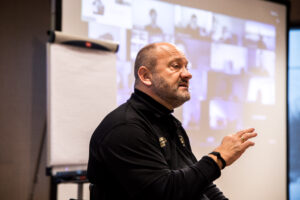

The first part of"The Power of Language"took place in new premises at the Waldhotel near Stuttgart in a completely different atmosphere. This time it was on a smaller scale, with 25 people taking part. This gave us the opportunity to prepare the participants intensively for the exciting journey of "The Power of Language" on the very first evening. Everyone listened intently and attentively to Boris Grundl's introductory words. Even then, it was clear what the journey was all about. The travel backpack was packed with the first items, such as the important filters in communication: erasing, distorting, and generalizing.
Gradually, the participants learned about the stumbling blocks of communication. But theory is all gray: Hedda Lauer challenged everyone with practical exercises on the first six of a total of twelve language programs. It is quite a challenge to recognize and use your own language patterns.
Do you recognize your own speech patterns?
To give you an idea of what we mean by language programs, I would like to invite you on a short mental journey: Imagine that your partner has an expensive Mercedes in the garage. Outside, you have a small Smart car that you use for shopping in the city. One evening, your partner comes home and says,"Come outside." Next to the Smart car, you discover a bright red Ferrari. Are you familiar with the statement, "But honey, what will the neighbors think of us?" Your partner replies,"I don't care."In this example, your partner is speaking from the language program of the inner frame of reference, which means that he or she makes decisions based on their own feelings. You, on the other hand, are speaking from the outer frame of reference; what other people think is important to you.
This knowledge was also applied in further intensive practical exercises: In "speed dating," I asked the participants to observe their own patterns in conversation and at the same time to perceive the programs of the other people. Those who wanted to go one step further practiced addressing their counterparts directly in their language programs. Within a very short time, the temperature in the room rose due to lively conversations, juggling different programs, and rising emotions.
Important prerequisite: Emotional receptiveness
Emotional receptivity is also an important topic in communication—how people not only convey something in communication, but also reach others emotionally. This was accompanied by other important tips and helpful tools.
The afternoon of the second day belonged to Boris Grundl. He taught the remaining speech patterns and again gave everyone plenty of time to practice intensively. To make sure nothing was forgotten, I used an exercise that enabled the participants to internalize the twelve speech programs in a very short time using a body list. This was just the first step on a long journey, because the real work begins now. Daily practice is necessary to master the programs. Boris Grundl made this clear once again in his closing remarks.
This knowledge can also be deepened in the seminar "The Power of Language Part 2" from December 8, 2016, to December 10, 2016.
We look forward to seeing you!