
There has rarely been a time when decisions have been so eagerly awaited in our world and from politicians as during this crisis. It is not only politicians who have to make decisions every day; each and every one of us is also deciding how to deal with the issue these days. It seems as if everything out there is about decisions, and we often wish for our normal lives back. However, when we think about it carefully, we realize that our whole lives, and therefore every day, are full of decisions. Often, we no longer really notice them in some respects.
That's how it was for me in a handball game. Many decisions are made over the course of 60 minutes. Whether by the coach, the referees, or above all by the players. For me, this is often not a conscious process, because these decisions come from intuition. As a playmaker in the center back position, I have a lot of contact with the ball and regularly make decisions that can lead to the team's success or failure. I often have very little time to do so. A handball game lasts 60 minutes.
Someone recently told me that they had analyzed how long I actually hold the ball in my hands during a game. It's only two to five minutes. That's not very long. When you consider the number of decisions that need to be made, you realize how quickly they have to be made. My wife would certainly be happy if I could integrate the quick decision-making from my sport into our everyday life. Because there, it can take much longer.
I have made my decision.
We want to use the time we have available to make the best possible decision. We weigh up the pros and cons, consider all the options, until eventually all the facts are on the table and we make a decision. Last year, I had to and wanted to make some far-reaching decisions, and I did so. I decided to end my career after 17 years—and yes, it wasn't an easy decision for me. Many people approached me and said it was the right decision, while others emphasized that I was still far too young to stop. I didn't make my decision based on right or wrong, but on what felt best for me in my current situation and my thoughts about my professional and personal future. Whether it was right or wrong can only be analyzed in hindsight.
Even after it was clear that the Handball Bundesliga season would be canceled due to the coronavirus crisis, bringing my career to a premature end, the question arose again as to whether I wanted to continue playing. Surely I couldn't want to end my career like this. It wasn't the "perfect" ending. But is there such a thing?
Should I or shouldn't I?
But that was never an option for me. Why? I made a decision at a certain point in time. At that moment, I consciously said goodbye to the alternative—to continue playing. After making that decision, I enjoyed every game I played on the field. My serious knee injury last year also made it clear to me that another injury would end my career prematurely. I took that risk every day. Of course, you can change your mind, but that would be inconsistent and reflect the many inner voices that are inside you. I call them "inner teammates."
Everyone knows the situation: Should I or shouldn't I? If only I had... Everyone has many "inner voices" that want to guide them in such situations and that they must learn to deal with. If you have a clear idea of what you want to achieve with a decision, certain voices become clearer and a certain personality develops that is reflected in our character.
I came to exactly the same conclusion on the playing field: the more time you have to make a decision, the more you start to think and weigh things up, and perhaps take too much information into account. Your "inner teammates" start to have their say. Your real teammates come up to you and want to influence you. In addition, the coach on the sideline also gives you a nudge. And all of this happens in a matter of moments. You may be familiar with such situations from your everyday life or your job. So what do I rely on? On what I have learned through years of experience, which is why I often don't have to think about it for long. On the "strong, inner teammates" within me. Making decisions, accepting them, or often even putting up with them is an important part of the process of making decisions intuitively. I certainly haven't always made the right decisions, but the important thing is to learn from them.
I wish you every success.
Yours sincerely, Martin Strobel
[mks_col]
[mks_one_half] [/mks_one_half]
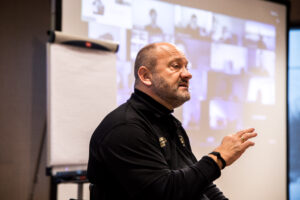
[mks_one_half]Martin Strobel is a German handball player (HBW Balingen-Weilstetten) who was forced to withdraw from the 2019 World Championship after suffering a serious knee injury in the main round.[/mks_one_half]
[/mks_col]
Images: © Marco Wolf