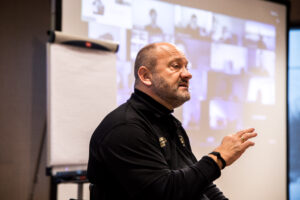

Globalization, digitalization... hardly anyone can escape it: change processes are on everyone's lips. What leads to frustration and conflict in many places is how these changes are dealt with. In today's article, we present Prof. Peter Kruse's eight rules in a somewhat unusual way, which you can use to purposefully torpedo change.
1. "Only behave in extremes!"
Rule number 1 highlights that people often display one-sided behavior. In times of change, factors such as uncertainty play a major role. Some people respond to this by compulsively trying to control everything. In doing so, however, they stifle the dynamics within the organization. The opposite of this would be to remove yourself completely and no longer provide any guidance. While this increases dynamism, it can drastically reduce the ability to make decisions and reach consensus. An effective approach would be to strike a balance between letting go and taking action in order to respond to the needs of the organization as the situation demands.
2. "Discussions about change should primarily take place informally—spread rumors!"
This rule aims to ensure transparency in change processes. Often, the top management level decides on changes that are to be gradually implemented throughout the company. The less that is said about the intention, goals, and purpose of the changes, the greater the breeding ground for fears, interpretations, and rumors.
3. "Ensure that people are constantly overwhelmed!"
Usually, many topics are initiated simultaneously or in quick succession. A new project here, an important change there. Preferably, everything should be completed by yesterday. Instead of announcing only short-term measures—which are sometimes necessary, especially in the operational area—long-term measures are very effective. People systematically underestimate how long sustainable change processes take to be implemented in practice. Don't believe it? Try the following little experiment: Starting today, tie your shoelaces the other way around. The goal is that in a stressful situation, you no longer think about it and still use the new technique...
4. "Encourage comprehensive competition within the company!"
The issue here is that enormous pressure is often exerted in the desire to motivate employees. This often leads to uncertainty and anxiety. It has also been proven that stress and confinement impair the brain's ability to think creatively. But this is precisely what is so important when it comes to change. After all, it is about breaking out of existing patterns and finding new ways forward.
The metaphor for this: When fishermen want to transport crabs caught in the sea to land, they always put at least two of them in a basket and leave it open. Why don't the animals simply crawl out? The fishermen use the principle of internal competition. Even though the animals strive to leave the basket, the crabs that climb up are always pulled back down by their fellow crabs as soon as they leave the common ground. This creates a high level of dynamism in the basket – analogous to the organization – but it also increasingly blocks progress.
5. "Find the culprit!"
This rule is particularly popular in German-speaking countries. When problems arise, companies almost instinctively look for the reason, the cause, the why, and above all, the guilty party. Extensive analysis is carried out. Of course, understanding the problem is justified. The question is, what specifically changes when blame is assigned? Instead of talking about blame and the past, it is more effective to discuss responsibility a possible vision of the future without devaluing the past. Ask more often: What are we doing this for (instead of why)? What was good about the old way?
6. "Never discuss the merits or shortcomings of existing rules in public!"
"We've always done it this way." The rules established in the past were justified in that very old system. When change processes are imminent, companies should urgently review these rules. This does not mean simply throwing all regulations overboard, but rather consciously and jointly examining whether they are still fit for purpose, i.e., effective in relation to the new desired state.
7. "Ensure quick commitment!"
In order to be able to emotionally engage in a process of change, it helps people to have the opportunity to think through the consequences for themselves and others. This creates initial identification. Inner clarity grows as to what emotional price must be paid. Too often, a quick commitment is insisted upon, which is usually only intellectual in nature, without the people concerned having really said "yes" inwardly. What price are you willing to pay?
8. "The pace of change at the decision-making level must be faster than at the implementation level!"
We often see people in companies developing a fundamentally skeptical attitude toward change processes. The term "change management" in particular is often heavily tarnished. This is primarily a matter of trust: if I repeatedly see that certain things are promised but not implemented, integrity suffers (words and actions do not match). Trust in change declines. In many places, change is associated with the course of the flu: "It will be a little unpleasant for a short time, but after two weeks at the latest, we will have gotten through it and everything will continue as before..."
Dear readers, we hope we have been able to raise your awareness of how to deal with change, both in yourself and in organizations. We recommend watching the video by Prof. Kruse, who presents the topic in his own unique, humorous and inspiring way and who provided the basis for this article.
That's why you're not really happy.
Why success and fulfillment have nothing to do with each other.