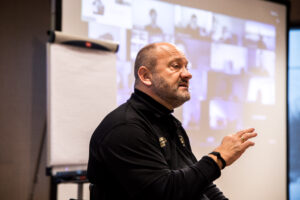

How would you rather spend your time, at the cinema watching an exciting film or in the meeting room at a meeting?
Why do you prefer going to the movies rather than attending meetings? Quite simply because meetings are often boring and movies are not. It's tragic when you consider which has more impact on your life. How relevant is a movie to your life? You are passive and have no influence on the plot. The movie may inspire you to think, but what actions result from 90 minutes in the cinema?
Meetings, on the other hand, are highly relevant to your life. Because you make decisions that affect your future! And, incidentally, they usually last 90 minutes. In theory, they could be much more appealing than any movie, because meetings are interactive. As a participant, you can intervene in the proceedings.
But what element is missing in meetings? What can and must we add to change this? Good films deal with tense situations that need to be resolved. With conflicts and disputes.
And it is precisely this element of tension and debate that I find lacking in meetings! When there is no consensus on certain points, discussions end far too early. The motto is: he who crawls does not stumble...
Why is that? In my opinion, it is the loyalty demanded by managers and often misunderstood. This becomes an obstacle in the blockbuster "Meeting on Monday." Because the question arises as to who is perceived as loyal. Usually the yes-men who take their superiors' word as law and implement it unconditionally. Those who applaud their boss's point of view in meetings and agree with them in personal conversations pass the loyalty stress test.
On the other hand, anyone who expresses their opinion is perceived as disloyal, but only if it differs from that of their superior. Anyone who calls a crazy idea a crazy idea. Contradiction is taken as an insult.
What characterizes true employee loyalty? It is when employees point out risks, dangers, mistakes, and difficulties. Most leader because they find it difficult to recognize reality, as they are surrounded by employees who seek harmony and present them with a distorted picture.
It takes courage to ask employees for critical feedback. It takes even more courage to accept it. See it as a sign of trust when employees express criticism! Learn to appreciate such situations instead of trying to prevent them.
Here's how to direct your own personal meeting blockbuster:
- Address the issue of seeking harmony. Explain what healthy debate leads to and how important it is. In doing so, foster a culture in which such debates can take place.
- Be alert to unspoken differences of opinion in meetings. Ask questions and probe deeper. Encourage participants to openly discuss their differences. A misunderstood concept of harmony can be inhibiting.
- Maintain this tension of confrontation, even if it makes you unpopular. After a storm, the air is clearer; after a confrontation, harmony returns.
- Consider a consensus reached too quickly to be critical. It is highly unlikely that several participants will agree on a single opinion on complex issues.
- Encourage committed, unfiltered, and energetic discussions. Argue properly.
- Clarify your role. Are you leading the meeting or are you a participant? And more importantly, let everyone know.
- If no agreement can be reached, the supervisor will decide.
- Regardless of your initial position, support the decision that has been made.
That's why you're not really happy.
Why success and fulfillment have nothing to do with each other.