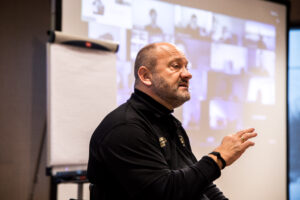

A seminar participant asked us for advice some time ago: "During my meetings, there are always participants who get so bogged down in details that the meeting goes way over time. It's hard to get the participants back on track." When asked how she would currently resolve these situations, she replied: "I usually put up with it, get annoyed, and say nothing."
We then recommended that she start the meeting with a metaphor or a vivid introduction. She then opened the next meeting as follows: "Welcome to today's meeting. To ensure that everything runs smoothly, we will first reach cruising altitude. This means that, like a passenger jet flying twelve kilometers above the earth, we will take a bird's-eye view of the topics. Once we have done that, there will be room to look at individual areas again from a helicopter's perspective. Here there is room for detailed questions, just as a helicopter sees the world in much greater detail. Is this approach okay with the participants?"
After two weeks, she called us and explained: "The airplane metaphor is now a running joke in meetings. Participants refer to it more often and tend to go into less detail..." In this article, let's discuss how this result came about...
What is a metaphor?
First, let's look at what metaphors are in their original sense: The word "metaphor" comes from Greek and means "transfer." We speak of a metaphor when a sentence or word is not meant literally, but figuratively, i.e., in a figurative sense. Examples:
- "I'm torn."
- "I was completely taken aback."
- "He's in for a nasty surprise."
- "His manner breaks my heart."
Why are metaphors effective in communication?
We can reach other people much more quickly through metaphors and figures of speech. They activate, motivate, and enliven communication. At the same time, vivid statements help to explain complex relationships in an understandable way. They are the ideal vehicle for ensuring that information reaches the other person more quickly. There are various reasons for this, which can be better explained by brain research.
The more effectively the brain can link things to existing knowledge, the easier it is to remember something. The best way to remember something is to express it in images. We love to think in images. They are not only cognitively richer, but also emotionally richer. That's why politicians, for example, like to use metaphors so much. In reality, we help each other to create images in our brains. The goal: greater and faster understanding!
"Emotion is the fast lane to the brain!" – Doug Stevenson –
Below are three examples that illustrate in a playful and simple way how rational facts can be explained emotionally and visually:
Image 1: "The Marathon"
Facts: A teenager is considering dropping out of school early due to poor grades.
Rational statement: "Don't give up. I believe you can do it. Keep at it!"
Emotional image: "School life can be compared to a marathon. There are many highlights (water stations, cheering spectators, thoughts of victory), but also low points (cramps, thoughts of giving up, doubts). It is important to realize that there are good phases and less good phases!"
Image 2: "The Airplane"
Situation: A person helps others too much and neglects themselves in the process.
Rational statement: "Pay more attention to yourself; you can't always just help others!"
Emotional image: "Helping others is like being on an airplane during a loss of cabin pressure. The rule is: first put on your own oxygen mask and then help the people next to you. Take care of yourself first and then others."
Image 3: "The Midwife"
Facts: A trainer wants to recommend that seminar participants ask more questions in employee appraisals rather than giving advice (see article "Ask or tell? That is the question!").
Rational statement: "In leadership, it is important to increase the proportion of questions and give less advice."
Emotional image: "Asking questions and giving advice is like being a midwife. What does a midwife do? That's right, she helps with the birth, bringing babies into the world. She brings something to light and doesn't add anything new to the mother. The same applies to employees. It is more effective to elicit information by asking questions than to burden them with new things by constantly giving advice!"
Do you notice the difference between rational and emotional statements?
Of course, there are no limits to creativity when it comes to creating images. We invite you to try it out and find your own personal way to reach your fellow human beings more quickly through visual language.
If you trulywant to delve deeply into the topic of figurative language, then take advantage of theDeveloping Questionsmodule in our online learning platform. You’ll receive clear, step-by-step guidance on how to take your personal integrity to the next level and significantly enhance your impact. Provided you consistently work through this module, we guarantee you’ll achieve a personal breakthrough in this area. (Simply click the button to access exclusive video content and practical workbooks.)

Image source: ©schmidtie Pixabay