Successful leaders know how to make an impact when it comes to managing people. The distinction between goals and results plays an important role here.
What is the difference between a task, a goal, and a result?
A task could be described as an action that has a specific purpose. For example:"I shoot arrows at the target"or "I manage a project."
A goal is something that an action is deliberately aimed at, or something that someone seeks to achieve as a purpose or objective. It is a desired result that has not yet been realized. Applied to the examples, this means:"I want to hit the center of the target"or "I will successfully complete this project."
A result is the consequence of an activity. It is a realized effect that represents a certain state. One could also say that an achieved goal is a result or measurable outcome.
Examples: "The arrow is stuck in the center of the target."or "The project has been successfully completed."
Put simply, one could say that a specific task usually has to be performed in order to achieve a goal. Once this has been accomplished, one has a result. A task can also be undertaken without it having any benefit, whereas the effect of a goal or result is measurable.
What is the difference between a goal and a result?
In terms of content, the goal and the result are often identical. But it makes an emotional difference whether a coach says, "In 2018, we will be world champions!" or "In 2018, we are world champions!" This is about more than just a tense. When the statement is formulated in the present tense, it has a stronger effect than in the future tense. Why is that? The example with the arrow helps to understand the difference.
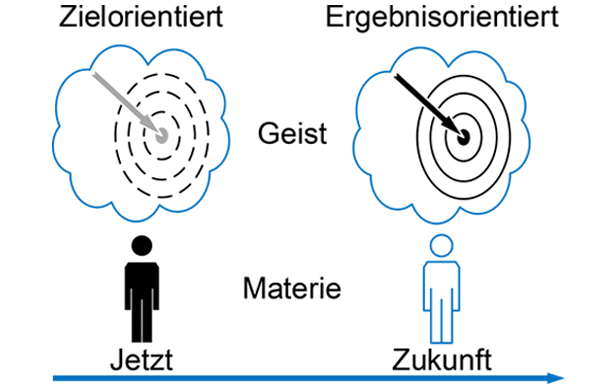
In the first case, everything is described from the here and now. I am standing with my bow and arrow away from the target and intend to shoot the arrow into the center. My body and mind are in the same place—both spatially and temporally.
In the second case, a future state is described in the present tense, as if the result had already been achieved. Although my body must be in the here and now, my mind can travel anywhere it wants – both in terms of location and time. I can imagine myself being somewhere else entirely.
So, mentally, I can already have completed an action, even though I haven't actually even started it yet. You can create a future reality in your mind. It is therefore possible to feel, see, hear, taste, smell, experience, and sense right now what it's like to spend your vacation on a wonderful South Sea island. I can mentally recline on a deck chair, look out at the sea, listen to the surf, enjoy a cool drink, and be completely relaxed, even though I am actually sitting in a dreary office building feeling frustrated. However, Result Orientation nothing to do with daydreaming! It's about how you think and what you focus on.
What do goal orientation and Result Orientation mean?
In terms of content, there is no relevant difference between goal orientation and Result Orientation. However, the effect is different. Since with goal orientation I still have the path, the work, the effort, etc. ahead of me, Result Orientation is Result Orientation more attractive because the desire is already a reality in my mind. This can be seen in the examples: "In 2018, we will be world champions!" or "In 2018, we are world champions!" In the first case, there is still a lot of training and hard work ahead. In the second case, the celebration is already taking place in the mind.
French writer and pilot Antoine de Saint-Exupéry (1900–1944) wrote: "If you want to build a ship, don't drum up people to collect wood, assign tasks, and divide the work, but rather teach them to long for the vast and endless sea."
The whole thing is based on a simple principle: matter follows spirit. Much of what surrounds us was nothing more than an idea before someone set about turning that idea into reality. Humans have invented many useful things. In each case, the starting point was always the need to achieve something. Humans had to find a solution to a desire or a danger because they absolutely wanted or needed the result.
The effect of Result Orientation be imagined as a pull that ensures that you almost inevitably achieve what you desire. The intense visualization guides us repeatedly toward the result, like an infinitely long and elastic rubber band. If the tip of the arrow were connected to the center of the target by an elastic thread, it would still hit the target even if a strong gust of wind disrupted its flight. Similarly, Result Orientation helps us find a way to achieve the desired state, even when we encounter resistance or obstacles. There is no need to specify a solution if a result is so desirable that we want to achieve it at all costs. The tasks arise from the situation and from the desire to achieve a result.
With goal orientation, on the other hand, repeated checks and corrections are necessary in order to ultimately achieve a goal. You have to keep realigning yourself with the goal as soon as deviations occur. Unfortunately, there Result Orientation no automatic correction as with Result Orientation . As soon as disruptions or even obstacles arise, a solution must be found and realignment is imperative. This pressure to achieve the goal is less effective than the pull toward the mentally and emotionally anticipated result.
Is it about activity or impact?
Those who are results-oriented make themselves measurable because the results to be achieved are predefined in terms of quality and quantity. At a predetermined point in time, the only thing left to do is to check whether reality corresponds to what was planned.
In our leadership training courses, we teach managers the benefits of Result Orientation. Many people are activity-oriented rather than impact-oriented. Those who are constantly active may feel tired and have the sense of accomplishing something, but effort alone does not equate to success—only results can be sold!
If Result Orientation is already a matter of course for you, you will have realized where your success comes from. What's more, you can use this knowledge to help people around you who tend to be more activity-oriented. What would change if all your colleagues were results-oriented? Those who are impact-oriented say: "I don't work—I produce results!"
If you are interested in the topic Result Orientation , then take advantage of theResult Orientationmodule in our online learning platform. You’ll receive clear, step-by-step guidance on how to elevate your personal integrity to the next level and sustainably improve your impact. If you consistently work through this module, we guarantee you’ll achieve a personal breakthrough in this area. (Simply click the button to access exclusive video content and practical workbooks.)