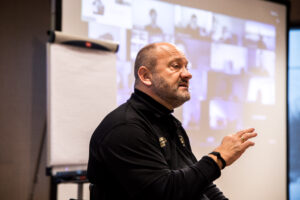

Are you also facing change projects? Have you and your team already recognized the need for change in your company? Have you already implemented some changes with great success, but find that individual employees or colleagues keep falling back into old patterns and habits? Or do you have new goals for your department, but no idea how to implement them in order to achieve better results? Then you are facing similar challenges to those faced by the participants in an in-house training course a few days ago. They had decided to take an in-depth and focused look at the topic of "leadership in change processes." As you know, individual challenges are just drops in the ocean of a successful transformation process.
At the beginning of the seminar day, a model that initially appears quite simple regularly leads to valuable discussions and exciting debates. All of leader employees present gain profound insights for themselves and for implementation. That is why I have decided to share this part of the day with you—so that it moves, touches, or inspires you and encourages you to reflect just as it did the participants.
The"learning zone model," which originated in experiential education, describes how people learn and, above all, why many people often find it difficult to accept and implement new ideas despite rational insight. You all know and love the reason for this: the comfort zone.
Accepting and implementing new things is often difficult.
People feel comfortable in their comfort zone. They have settled in well here over the years and made themselves comfortable. Within this zone, they deliver solid results on autopilot, so to speak, and complete all the tasks assigned to them without much effort and without thinking too much. There is a feeling of trust here; they feel safe and secure. The problem? You already know that too:
Change only happens outside your comfort zone
In the seminar , I always ask the same question at this point and receive an answer that is quite correct—but only partially so. The question is:"What is the area beyond the comfort zone?" Without hesitation, the answer is usually something like:"That's the panic zone!" Recently, one participant even added, "Nothing happens here anymore..."And after a long pause, " ...or there's trouble!"
What the participant means by this are the two fundamental negative behaviors that employees usually exhibit when they find themselves in this zone. These are essentially: passivity – i.e., retreating home to the comfort zone – or activity in the form of tiresome discussions and resistance, which often resembles fighting windmills (see also The fear of change – from rational understanding to emotional implementation and Overcoming the fight-or-flight response). The causes of this behavior are identical in both cases: it is the result of feelings of fear and disorientation experienced here, which can develop into panic.
Comfort zone and fear zone—is there nothing in between? YES!
There is a space between the comfort zone and the fear zone, a very large one in fact – the so-called learning zone: a space for development and growth. Only here, outside the familiar world, can potential be discovered and developed. Only if you dare to take a step outside – no matter how much the safety ropes pull you back – will you discover what is possible. Only then will you recognize the opportunities and possibilities that you and your team have not yet exploited, waiting to be discovered and seized.
The false assumption that outside our familiar surroundings there lurk only dangers and uncertainties repeatedly fuels the fatal desire for everything to be different and better—but without any effort, please. But one thing is clear:
Success is what follows...
...namely action, curiosity, movement, and not passivity or reserved observation. Development and growth only take place in the learning zone. Here, you are challenged and challenge your employees at the same time—without overwhelming them. Here, you and your employees enjoy new experiences, celebrate successes, and deal constructively with failures. The direction of energy and attention in this zone is clear: it's about moving forward step by step. Opportunities for action are recognized, goals are achieved together, and self-efficacy is experienced. Self-confidence increases – in you, your employees, and the team. The steps toward successful change automatically become bigger. All you need is the certainty that you can take a step back if you cross the growth zone.
Comfort zone, learning zone, panic zone: as individual as the person themselves
But how can you, as leader where an individual's comfort zone ends and their fear zone begins? How can you identify the growth zone(s) of your employees and the team, and above all, how large and developable this zone is? And how can you gradually achieve this further development by encouraging and challenging them?
If you are also asking yourself these questions and would like to learn more,
- how you can actively manage or even initiate change processes to ensure long-term competitiveness
- What options you have for identifying resistance to change projects at an early stage and harnessing this energy to achieve better results.
- How to create a culture of accountability in times of change
- how to implement results-oriented systems to stabilize the performance of processes and structures in the transformation process and achieve measurable performance improvements with your team
- What principles you need to follow in order to put together effective change teams as drivers and supporters of transformation within the company
- how to build confidence in yourself, your role as leader the transformation process,
Then feel free to find out more about our online learning world on the topic of "Effectively managing change processes."
That's why you're not really happy.
Why success and fulfillment have nothing to do with each other.