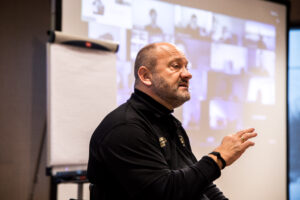

Recently, Benedictine monk Anselm Grün gave a lecture at a conference. His topic: values and living moderately, or the art of finding the right balance. This topic is extremely fascinating, not least because we at the academy are constantly dealing with this question in our first "leadership pillar": How do I lead myself?
Anselm Grün pointed out that many people today have exaggerated images of themselves and often feel inferior because of these excessive expectations. This feeling of inferiority then leads to self-rejection. But where do these excessive expectations come from? The priest sees the cause in low self-esteem and the resulting self-deprecation.
In coaching, I also occasionally encounter leader who experience leader and express dissatisfaction because their grandiose self-image or overly high expectations of themselves do not correspond with reality. Nevertheless, these leader cling to their exaggerated images and accept that this makes them feel bad. Their own grandiosity—always wanting to be special in everything—is simply more tempting than taking a clear and sharp look at their own blind spots. It would certainly make more sense to gradually let go of these grandiose self-images and accept themselves and their own averageness as it is, with their respective strengths and weaknesses. That's easy to say, but not so easy to do!
Accepting one's own mediocrity
Who likes to admit that they have extremely low self-esteem in a certain area of their life and are therefore a "little worm"? I know very few people who do this and thereby initiate their own transformation. Unfortunately, far too few. However, recognition is the basic prerequisite for effective change.
Anselm Grün illustrated that people will eventually be confronted with the truth and with their own mediocrity if they are willing to look there. In his view, it is not good to live beyond one's means for years and to burden oneself with excessive images of one's own grandeur.
Michael Jackson was an extremely prominent example of this phenomenon. Do you know which music album is the most successful worldwide (in terms of sales figures)? It is Michael Jackson's 1982 album "Thriller." With approximately 65 million copies sold, the album still ranks number one today. In an interview shortly after this "world record," Michael Jackson boasted that this was only the beginning of his success and that many more albums with even better sales figures would follow. Far from it! Even after 34 years, "Thriller" is still the best-selling album worldwide. History has shown what excessive expectations and exaggerated goals have done to the pop star's life. (http://www.welt.de/print/wams/wirtschaft/article142441975/Die-Michael-Jackson-Falle.html)
After Anselm Grün's lecture, I really thought about how it is possible to accept one's own mediocrity on the one hand, but still achieve top performance on the other. At first, I couldn't quite wrap my head around it.
How can I describe myself as average these days, when everyone is talking about elites, top performance, and the Champions League? Or do you want an average car? An average boss, or even better, an average partner? Hardly. If you are about to have knee surgery, you are more likely to consult a knee specialist with excellent results in their field than a general surgeon with little expertise in knees.
How do weaknesses and mediocrity fit in with top performance?
On average, all people are average. One person may be great at mental arithmetic, but have certain deficits in leadership. Another may be extremely communicative, but have a weakness when it comes to completing projects. So every person has great strengths and great weaknesses at the same time – that's what unites all people. But when it comes to dealing with these strengths and weaknesses, that's where the wheat is separated from the chaff, in my opinion. If a person is mindful of their talents, recognizes them, develops them into strengths, and continuously works hard on these strengths and develops themselves further, they are more likely to achieve something great at some point and possibly even achieve top results. And despite these top results, this person is and remains average overall – because they have great strengths and also great weaknesses. Thus, being average as a person and simultaneously achieving top performance in the context of their respective talents and strengths is not a contradiction.
Here are 7 steps for successfully implementing the ideas in this blog article:
- Accepting yourself: with your own talents and strengths, but also with your own weaknesses
- Set realistic goals: not too high and not too low
- Accepting one's own mediocrity and limitations, yet continuously improving and developing one's talents and turning them into strengths.
- In the context of your own strengths: What is the next step in your learning or development?
- Developing professionally in line with your own talents and strengths and taking on responsibility these areas
- Becoming the best I can be (in the context of my strengths)
- Always be disciplined, humble, and grateful.
From my experience in training and coaching, I know that truly successful leader people often don't believe that they are anything special. Often, they don't even care. Many achieve such amazing things because they are motivated by small, continuous steps of improvement. They simply believe firmly that they can develop step by step and then do so consistently. Translated into a metaphor: not climbing Mount Everest in a single step, but a continuous development from base camp to base camp. True to the motto: the journey is the destination.
There is only one Lionel Messi, but there are 10 million boys who chase balls around dusty fields... and don't score. There is only one Robbie Williams, but there are thousands of men and women who make fools of themselves in front of Dieter Bohlen and the TV audience. We humans make life difficult for ourselves by wanting to be successful or special in every area of life. In reality, only a few make it to the top. Because it takes enormous hard work and a lot of sacrifice to develop your talents and strengths to a "world-class" level in any context. Are you really willing to pay the price for that? Role models are good for learning from them in certain areas. But it never makes sense to completely copy someone else. Why? Because then you miss out on the best original, namely yourself!
If you are interested in reflecting on your own self-management (pillar 1: How do I manage myself?) and gaining new inspiration for your strengths and talents, then we highly recommend the self-management seminar Steh auf!(Get up!).