"The definition of insanity is doing the same thing over and over again and expecting different results."
This famous quote from Albert Einstein sounds logical. Nevertheless, this is exactly what happens to many people from time to time—they do the same thing and hope for improvement. The human brain is used to working in patterns. This refers to largely unconscious and highly automated processes that are activated by certain stimuli. If someone extends their hand to greet you, you will usually automatically extend your hand as well.
They also have patterns to motivate themselves to get up in the morning, to hold conversations, to delegate tasks... In principle, these patterns are helpful and necessary. Without automatic responses, high-performance sports, for example, would be unthinkable. But even everyday activities such as driving a car would only be possible with great effort.
Patterns function as unconscious competence
However, patterns in your everyday management activities can also prevent you from achieving the results you want. For example, do you experience disputes with colleagues that always follow the same pattern and lead nowhere? Or do you perhaps repeatedly clash with an employee in the same way during weekly coordination meetings? Your own patterns cause you to exhibit behaviors that in turn trigger certain patterns in your conversation partner. These patterns lead to a certain inner attitude. This often ends in a mutual withdrawal of receptiveness.
When your patterns are effective, you are operating at a subconscious level of competence. This is the state you are probably in when driving a car. You no longer have to think about it. You can pay attention to the scenery or have a conversation while driving. But this was not always the case. Just think back to your first driving lessons...
When you learn something new, you usually go through the following four stages of competence:
Unconscious incompetence:
You do not know or cannot do something. However, you have no idea that you do not know or cannot do it. Example: If you have never driven a car yourself, you do not know what it really means to be a driver.
Conscious incompetence:
You know that you don't know or can't do something. This stage is unpleasant. However, this is where you learn the most. Example: When driving, you grind the gears, stall the engine, or can't manage to park in reverse.
Conscious competence:
You know or can do something, but you still have to consciously focus on it. Example: You can drive a car, but it still requires your full concentration.
Unconscious competence:
You know and can do something without having to consciously think about it. Individual aspects have come together to form patterns and habits. Example: You may still consciously think about where you are driving your car, but the rest is done by your unconscious competence. While driving, your attention is free for other things, such as listening to the radio or having a conversation.
What can you do if one of your patterns is not effective? And stands in your way?
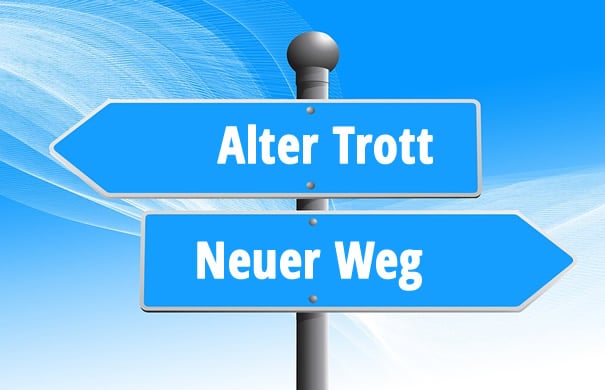
Your patterns have mostly developed unconsciously over the course of your life and left their mark. They are metaphorically laid out in the neural network of your brain as broad beaten paths. Change only occurs when you leave these old paths and deliberately set out on new ones.
This is possible because the human brain has the ability to change and adapt throughout life according to how it is used and stressed (known as neuroplasticity). Would you like to change an ineffective pattern? Then you need to move from the stage of unconscious competence back to the stage of conscious incompetence. This involves breaking a pattern down into individual sub-patterns and thereby unlearning it. You can then reassemble it in a different way to make it more effective.
Example: Conscious unlearning in practice
Let's say you're a good tennis player. You want to improve your serve, so you take lessons from a coach. The coach will probably watch you first and then start changing individual things such as your ball toss, posture, or racket swing.
In other words, he will break down something that was a complete pattern for you—namely, your serve—into sub-patterns. In doing so, he helps you to unlearn this pattern first. You then have the opportunity to change the sub-patterns (ball throw, posture, etc.). After that, you can combine the individual aspects into a new, more effective pattern—in this case, a better serve.
Which patterns would you like to change, and when will you begin?
We would be happy to support you in this area with our management training and coaching programs. I look forward to hearing about your experiences.
Your team at the Grundl Leadership Institute
Image source:©pixabay – Geralt